Johnny Carson Jokingly Asked Freddie Mercury to Sit at the Piano — The Entire Studio Went Sil
<!–
–>
Johnny Carson, the king of late night television, looked at Freddie Mercury and said, “You know what, Freddie? We have a beautiful grand piano sitting right there. Why don’t you play us something?” He said it with a laugh. The audience laughed, too. It was supposed to be a joke. What happened in the next 4 minutes made Johnny Carson go completely silent, made the studio audience forget to breathe, and proved that Freddie Mercury wasn’t just a rock and roll frontman.
It was something the world had never seen before and may never see again. It was October 1982, and the Freddie Mercury was in Los Angeles promoting Queen’s new album, Hot Space. The album had been controversial. Critics hated it. Fans were confused. The rock press was calling it a betrayal, saying Queen had abandoned their sound for disco and funk.
For the first time in their career, Queen was facing real doubt. Not from outsiders who never liked them, but from their own fans. The band was under pressure. Their American label was nervous. Radio stations that used to play everything Queen released were now passing on their singles. And in the middle of all this uncertainty, Freddie Mercury was booked on The Tonight Show with Johnny Carson.
It wasn’t a musical performance booking. Queen wasn’t scheduled to play. Freddie was there simply as an interview guest, something he rarely did because he was famously private, famously uncomfortable with the standard talk show format. He didn’t like small talk. He didn’t like explaining himself. He preferred to let the music speak.
But the label insisted. They needed exposure. They needed America to remember that Freddie Mercury was not just a controversy or a headline. He was a once-in-a-generation talent. So, Freddie agreed. He put on a simple white t-shirt, white trousers, and walked into NBC Studios in Burbank, California on a Tuesday evening.
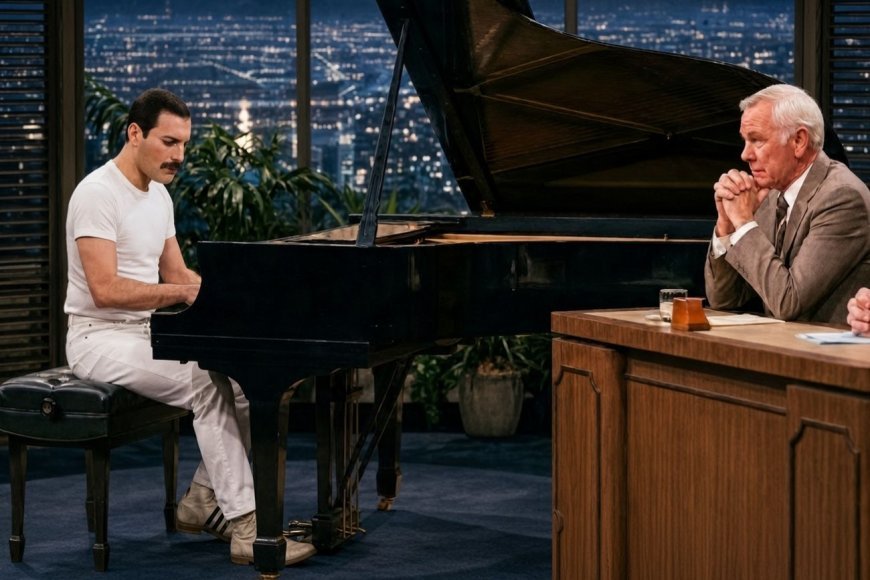
The Tonight Show studio was electric that night. Johnny Carson was in peak form, sharp, witty, commanding the room the way only he could. His desk sat center stage, a glass of something amber beside his notes, and that famous Burbank skyline glowing through the window behind him. The audience was the usual mix of tourists, industry people, and regulars who came every week like it was church.
Nobody knew what was about to happen. Freddie walked out to solid applause. Not the screaming hysteria of a Queen concert, but the polite, warm welcome that said, “We know who you are, and we’re glad you’re here.” He sat down in the guest chair next to Carson’s desk, crossed his legs, and immediately seemed slightly uncomfortable.
Carson noticed. He was brilliant at reading people. 30 years of interviewing had given him an almost supernatural ability to sense when a guest was holding something back. The interview started normally enough. Carson asked about the new album, about touring, about life in London versus Los Angeles. Freddie gave short, polite answers.
He smiled when he was supposed to smile. He laughed at Carson’s jokes, but there was something missing. The spark that made Freddie Mercury the most electrifying performer on Earth was nowhere to be found. He was being careful, guarded, professional, but distant. About 8 minutes into the interview, Carson sensed he was losing the audience. The energy was flatlining.
>> [clears throat] >> Freddie was giving nothing personal, nothing real, nothing that would make this appearance memorable. And Johnny Carson never let an interview die. That wasn’t who he was. He leaned forward, clasped his hands together, and looked at Freddy with that famous Carson half smile. The one that meant he was about to do something unpredictable.
“Freddy,” he said, glancing toward the grand piano that sat at the edge of the stage, used by the band between segments. “You know what? We have a beautiful grand piano sitting right there. Why don’t you play us something?” The audience laughed. Carson laughed. It was clearly a joke, a light-hearted way to break the tension of an interview that wasn’t quite working.
Freddy smiled, shook his head slightly, and said, “Oh, I don’t think anyone wants to hear that.” But Carson pressed. He had that glint in his eye, the one his producers knew meant he was going off script. “Come on,” Carson said, gesturing toward the piano. “You wrote Bohemian Rhapsody. You’re telling me you can’t sit down and play us a little something?” The audience started clapping, encouraging.
[clears throat] >> [applause] >> Freddy looked at the piano across the stage. Something shifted in his face. It was subtle, barely noticeable unless you were watching closely. The polite smile faded. Something deeper replaced it. Something private. He was quiet for a moment. Then he uncrossed his legs, stood up slowly, and said, “All right, darling, but don’t say I didn’t warn you.” The audience cheered.
They thought they were about to get a quick fun rendition of one of Queen’s hits. Maybe Bohemian Rhapsody. Maybe We Are the Champions. Something familiar, something safe. They had no idea. Freddy walked across the stage toward the piano. His walk changed. The slightly awkward interview guest disappeared, and something else took over. His shoulders dropped.
His chin lifted slightly. It was like watching someone step out of a costume and into their real skin. He reached the piano bench, stood there for a moment looking down at the keys, and then sat down. He didn’t adjust the microphone. He didn’t look at the audience. He didn’t look at Carson.
He just placed his hands on the keys, closed his eyes for 3 seconds, and began to play. The song he chose wasn’t Bohemian Rhapsody. It wasn’t any Queen song at all. It was Chopin’s Ballade No. 1 in G minor, a classical piece so technically demanding that most concert pianists spend years perfecting it. The first notes floated into the studio like something from another world.
Soft, delicate, almost hesitant, the way Chopin intended it to begin. The audience went quiet instantly. Not the polite quiet of people waiting for something to happen. >> [clears throat] >> The stunned quiet of people realizing they were witnessing something they didn’t expect. Carson’s smile disappeared. He leaned back in his chair, unfolded his hands, and just watched.
His producer later said he had never seen Carson react that way to anything in 30 years of television. The notes built slowly, the way a storm builds on the horizon. Freddie’s left hand moved across the lower keys with a precision that spoke of years, decades of practice. His right hand carried the melody, tender at first, then gradually more intense, more urgent, like a conversation growing from a whisper to a confession.
He played with his eyes closed. His body swayed slightly. Not the theatrical sway of a rock performance, but the unconscious movement of someone completely lost inside the music. The white T-shirt, the mustache, the image the world knew, none of it mattered anymore. What was sitting at that piano was not Freddie Mercury, the rock star.
It was Farrokh Bulsara, the boy from Zanzibar who started playing piano at age seven. The boy whose parents sent him to St. Peter’s boarding school in India, where he received formal classical training. The boy who spent hours alone in practice rooms while other children played cricket outside.
The piece moved into its more complex passages. Freddy’s fingers flew across the keys with a speed and accuracy that made the studio musicians in Doc Severinsen’s band put down their instruments and stare. These were professional musicians, people who played with the best in the world every single night. And they were staring at Freddie Mercury like they had never seen anyone play piano before.
3 minutes passed, then 4. The piece reached its emotional peak, the section where Chopin poured every ounce of heartbreak and longing into the composition. Freddy played it like he was remembering something painful. His fingers pressed into the keys with a weight that went beyond technique. This was not a man showing off.
This was a man speaking through the only language that had never failed him. When the final notes faded, Freddy lifted his hands from the keys slowly, the way you lift your hands from something sacred. He opened his eyes. And for a moment, he seemed surprised to find himself on a television set, surrounded by cameras and lights, as if he had genuinely forgotten where he was.
The silence lasted four full seconds. 4 seconds on live television is an eternity. Then the audience erupted. Not just applause. People stood up. Some of them were crying. A woman in the third row had her hand over her mouth. The studio musicians were shaking their heads in disbelief.
And Johnny Carson, the man who had interviewed every major figure of the 20th century, the man who was never at a loss for words sat behind his desk with his hands clasped together and tears forming in his eyes. He didn’t speak for a long moment. When he finally did, his voice was rough. Freddy, he said quietly, why doesn’t the world know you can do that? Freddy turned on the bench to face Carson.
His expression wasn’t triumphant. It wasn’t proud. It was something else entirely. Something that looked almost like relief mixed with sadness. He was quiet for a moment, looking down at his hands. Then he said something that nobody in that studio expected. Something that changed how everyone in that room understood who Freddy Mercury really was beneath the costumes and the bravado and the showmanship.
Because, darling, Freddy said, that’s not what they want from me. The words hung in the air like smoke. Carson leaned forward. The audience was completely still. Freddy looked at the piano, not at anyone in the room, and continued. When I was 7 years old, my parents put me in a boarding school in India.
I was terrified. I didn’t know anyone. I barely spoke the language properly. But they had a music room with an old upright piano, and I would sneak in there every night after the other boys fell asleep. He paused. His voice was quieter now, almost as if he was talking to himself rather than a live television audience of 11 million people.
That piano saved my life, not metaphorically, literally. I was so alone, so frightened, so far from everything I knew, and that instrument became my mother, my father, my best friend, my entire world. I would play for hours in the dark, just feeling the keys under my fingers, and for those hours, I wasn’t a scared little boy anymore.
I was someone else. Someone powerful. Carson didn’t interrupt. He didn’t crack a joke. He didn’t redirect. He just listened. “When I got older,” Freddy continued, “I realized that what people wanted from me wasn’t the piano. It wasn’t the classical training. It wasn’t the thing that saved me. They wanted the show.
They wanted the leather, the costumes, the spectacle. They wanted Freddy Mercury, and I gave them Freddy Mercury.” He looked at his hands again. “But Freddy Mercury is a character I created to survive. The piano, that’s for rock. That’s the real person underneath all of this.
And I’ve never quite known what to do with that, because the world fell in love with the character, not the boy who played Chopin alone in the dark.” The studio was so quiet you could hear the air conditioning humming through the vents above the stage lights. Carson reached under his desk and pulled out a handkerchief. He wiped his eyes quickly, professionally, the way a man does when he doesn’t want anyone to notice.
But 11 million people noticed. “Freddy,” Carson said, his voice still rough, “I owe you an apology. I asked you to play as a joke. I had no idea I was asking you to show us your soul.” Freddy shook his head gently. “Don’t apologize, darling. You gave me permission to do something I’ve wanted to do on television for 10 years.
Everyone always wants the show. Tonight, someone finally asked for the music.” He stood up from the piano bench and walked back toward Carson’s desk, but he didn’t sit down in the guest chair. He stopped halfway, turned back to look at the piano one more time, and said something so quiet that the microphones barely caught it.
“Thank you,” he whispered, and it wasn’t clear whether he was thanking Carson or the audience, or the piano itself. Carson stood up from behind his desk. In 30 years of hosting The Tonight Show, he had never done this for a guest. He walked around the desk, crossed the stage, and extended his hand to Freddy.
Freddy took it. Then Carson pulled him into a hug. The audience erupted again, louder this time. People were on their feet, tears streaming down faces throughout the studio. When they separated, Carson held Freddy by the shoulders and looked him directly in the eyes. “Promise me something.” Carson said. “Promise me you’ll never hide that again.
The world deserves to know Farrokh, not just Freddy.” Freddy smiled, but it was a sad smile, the kind that comes from knowing something the other person doesn’t. “The world isn’t ready for Farrokh, darling.” he said. “Maybe someday, but not yet.” After that night, the footage aired once, just once. NBC broadcast it live, and millions saw it.
But the clip was never officially replayed. Some say Freddy himself requested it be pulled from reruns. Others say the network simply didn’t know how to categorize it. A rock star playing Chopin on a late-night talk show didn’t fit any format they understood. But people who saw it never forgot. Musicians who watched that broadcast have spoken about it for decades.
Elton John once said in an interview, “I saw Freddy play Chopin on Carson, and I went home and cried because I realized I would never play with that kind of honesty.” Brian May, Queen’s guitarist, said he watched it alone in a hotel room in Tokyo and called Freddy the next morning. “Why don’t you do that every night?” he asked.
Freddy’s answer was simple. “Because that’s mine, darling. The rest belongs to the audience. But that belongs to me.” Freddy Mercury died on November 24th, 1991. He was 45 years old. In the years since, his legacy has grown beyond anything he could have imagined. But for those who know, for those who saw that Tuesday night in October 1982, there is another Freddie Mercury.
Not the frontman, not the showman, not [clears throat] the character in the leather and the crown. There is Farrokh Bulsara, 7 years old, alone in a dark music room in India, finding the one thing that would carry him through a life of extraordinary fame and extraordinary loneliness, the piano, the one true thing.
Johnny Carson kept a photograph on his office wall until the day he retired. It showed Freddie Mercury sitting at the grand piano, eyes closed, hands on the keys, completely lost in Chopin. Underneath it, Carson had written four words in his own handwriting, “The realest moment ever.”